Living Under Pressure: How Deep-Sea Animals Survive the Crush
Pressure is the deep sea's defining condition — more than cold, more even than darkness. It shapes what can live there, what a body must be made of, and why bringing an animal up is so often fatal.
Why pressure climbs so fast
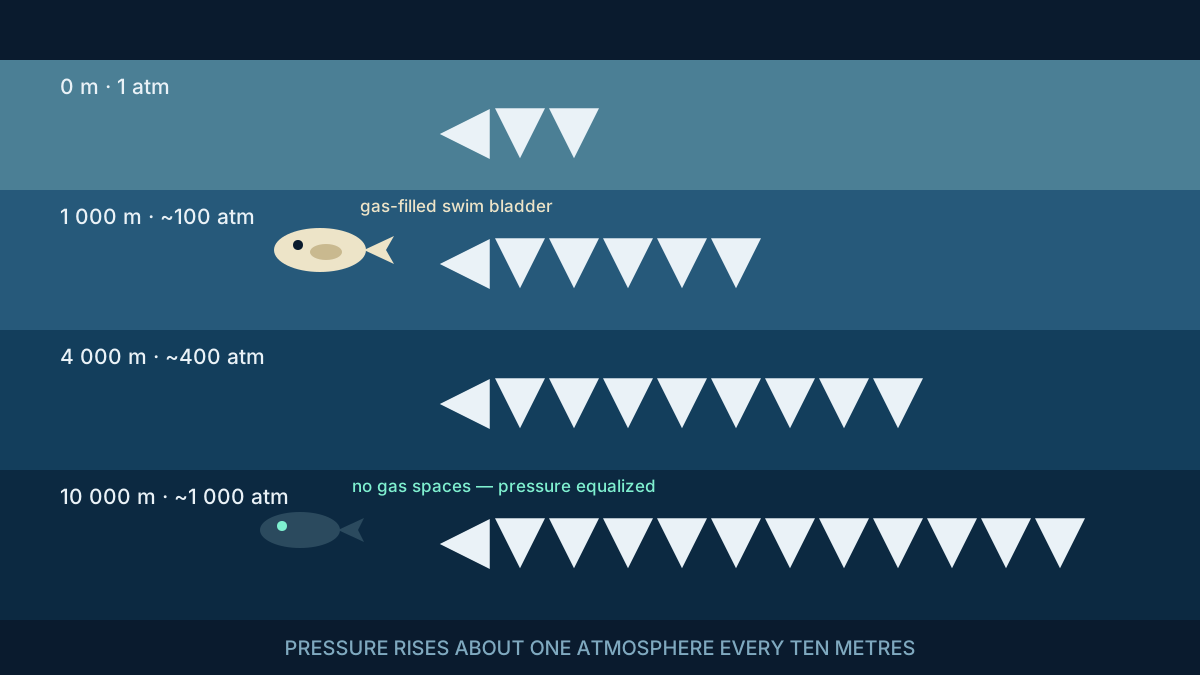
Water is heavy, and every ten meters of it adds roughly one atmosphere of pressure. A few hundred meters down, the load is already many times what we feel at sea level; in the deepest trenches it is hundreds of times greater. The increase is steady and unforgiving, which is why depth is the deep sea's real currency.
Gas is the enemy, not water
The reason pressure destroys machines but not fish is compressibility. Air spaces collapse; water and tissue barely change volume. Deep-sea animals simply do without gas: many lack swim bladders entirely, or fill them with fat instead of gas, so there is nothing inside to be squeezed.
Adaptations at the molecular level
Pressure also deforms proteins and stiffens cell membranes. Deep-sea organisms answer with membranes built to stay fluid in cold, high-pressure conditions and with protective molecules that keep proteins working. These are chemical solutions, not structural ones — which is why they cannot simply be switched off on the way up.
Coming up is the dangerous part
Bringing a deep animal to the surface reverses everything at once: pressure drops, temperature rises, and tissues tuned to the abyss fail. This is why so many deep-sea species look distorted in photographs taken on deck, and why modern research increasingly studies them in situ, with cameras and pressurized sampling chambers instead of nets.

Conclusion
Nothing down there is "crushed" — the crushing is our problem, not theirs. Deep-sea animals are not surviving pressure so much as being built out of it, perfectly matched to a world we can only visit inside a sphere.
Frequently Asked Questions
How much does pressure increase with depth?
Roughly one additional atmosphere for every ten meters of seawater, so the pressure at great depth is hundreds of times that at the surface.
Why doesn't pressure crush deep-sea animals?
Their bodies contain almost no gas spaces. Water and tissue are nearly incompressible, so the pressure inside matches the pressure outside.
Can deep-sea fish survive at the surface?
Usually not. Rapid decompression and warmer water damage tissues and proteins adapted to high pressure and near-freezing temperatures.
Sources & Further Reading
Last updated: 6 August 2026